


Everyone knows relationships matter in government contracting. But knowing it and actually doing something about it are two very different things.
The reality is that in a market where technical capabilities and pricing are increasingly similar across competitors, the firms that win are almost always the ones that got there first—not first to the RFP, but first to the relationship. They spent time understanding what the customer actually needed. They shaped the requirement. When the RFP dropped, the outcome was already decided.
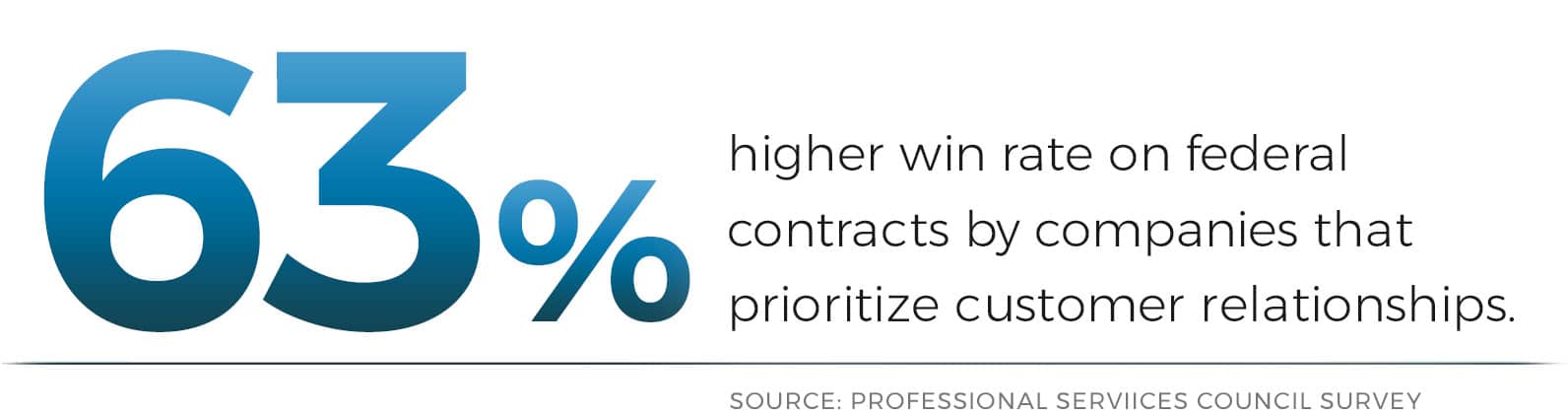
Recent surveys show 82% of of decision-makers say strong relationships are a key factor in awarding contracts. But only 28% provide training on relationship-building skills.
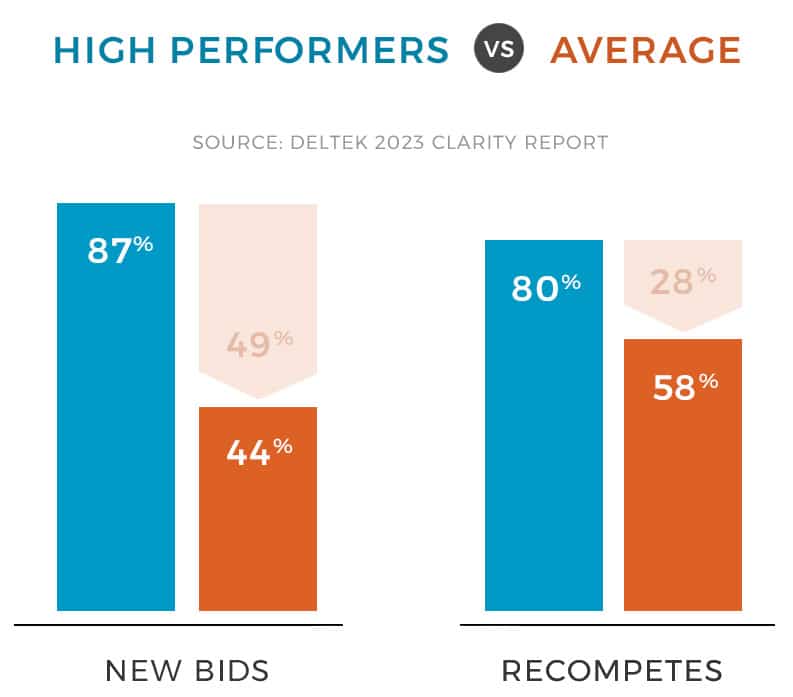
With Deltek finding you’re 80% more likely to win if your team excels in customer engagement, relationships cannot be ignored to succeed in government contracting.
This guide gives you the practical tools to do that: how to identify the right contacts, build trust over time, gather the intelligence your competitors don’t have, and measure how you’re doing. Whether you’re trying to protect a recompete or break into a new agency, the approach is the same.
Mapping Key Players & Strategies
Why Relationships Are Your Only Sustainable Advantage
While competitors scramble to respond to RFPs, relationship-driven contractors have already secured the win. Relationships can’t be reverse-engineered—they’re your only sustainable competitive advantage.
Winning Relationships® deliver measurable results:
- 30% increase in subcontract work through prime partnerships
- 12-18 months of early Intelligence on upcoming opportunities
- The influence to shape solicitations in your favor
- Protest resistance as agencies seek defendable vendor relationships
- Performance advantage as contracts shift to outcome-focused metrics
Know the Players: Your Relationship Map
Government contracting success requires understanding who makes the decisions and who can influence those decision makers. Winning contractors build relationships across multiple layers to create redundancy and capture diverse perspectives on upcoming needs.
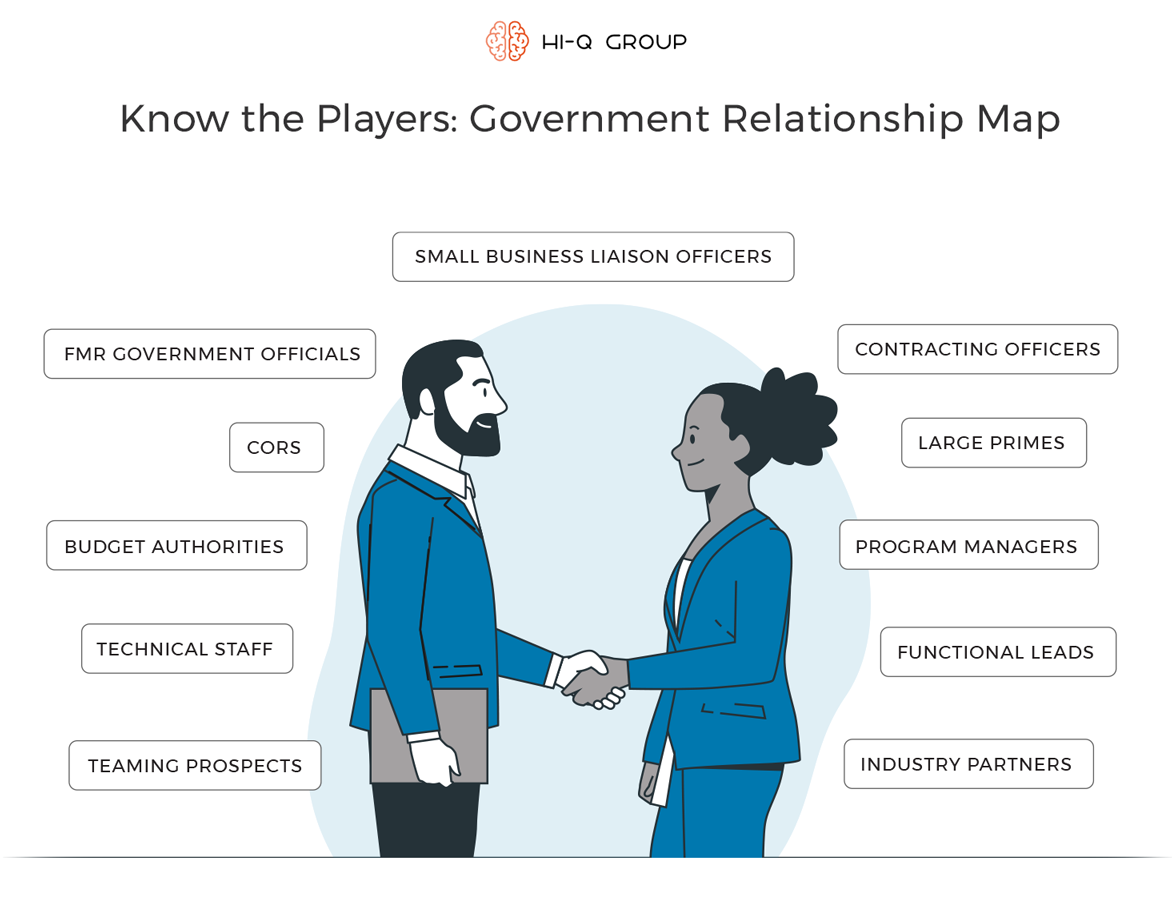
The Hi-Q Three-Tier Engagement Strategy™ ensures you’re positioned to win before the opportunity is released publicly. Let’s cover each of these three tiers:
The Hi-Q Three-Tier Engagement Strategy™
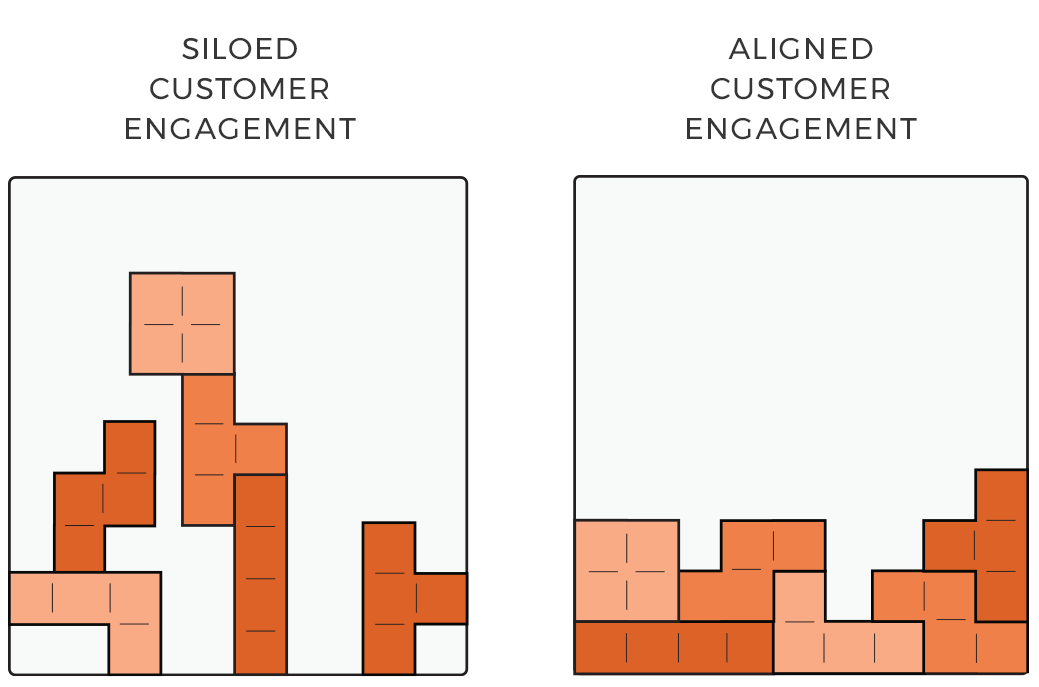
Balanced engagement across all three tiers raises your probability of win and prevents surprise losses from competitors you never saw coming.
Tier 1: Decision Makers
- Who: Program Managers, Contracting Officers, Budget Authorities
- Focus: Mission outcomes, compliance, contract risk
- Engage Through: Capability briefings, technical demonstrations, performance reviews
- Goal: Establish credibility as a low-risk, mission-aligned solution
- Strategic Value: Control requirements and vendor selection—your primary leverage point
For more information on this tier, read the Players and Layers Methodology®: How to Meet Federal Decision Makers by Summit Insight.
Tier 2: Influencers & Requirement Shapers
- Who: CORs, technical staff, functional leads, Small Business Liaison Officers
- Focus: Day-to-day effectiveness, operational challenges, set-aside opportunities.
- Engage Through: Working sessions, check-ins, problem-solving partnerships
- Goal: Influence the details that become requirements and evaluation criteria
- Strategic Value: Shape solicitations before they’re released—engage early and often
Tier 3: Advisors & Intel Sources
- Who: Former government officials, large primes, industry partners, teaming prospects
- Focus: Competitive landscape, agency priorities, procurement timing
- Engage Through: Strategic discussions, information sharing, networking events
- Goal: Gain early Intelligence and anticipate pipeline shifts
- Strategic Value: 30% increase in subcontract work through strong prime relationships
Building Trust and Timing
Trust: The Foundation That Makes Everything Else Work
Here’s the truth: Without trust, your “relationships” are just professional acquaintances who return your calls. With trust, you get the intel that wins contracts.
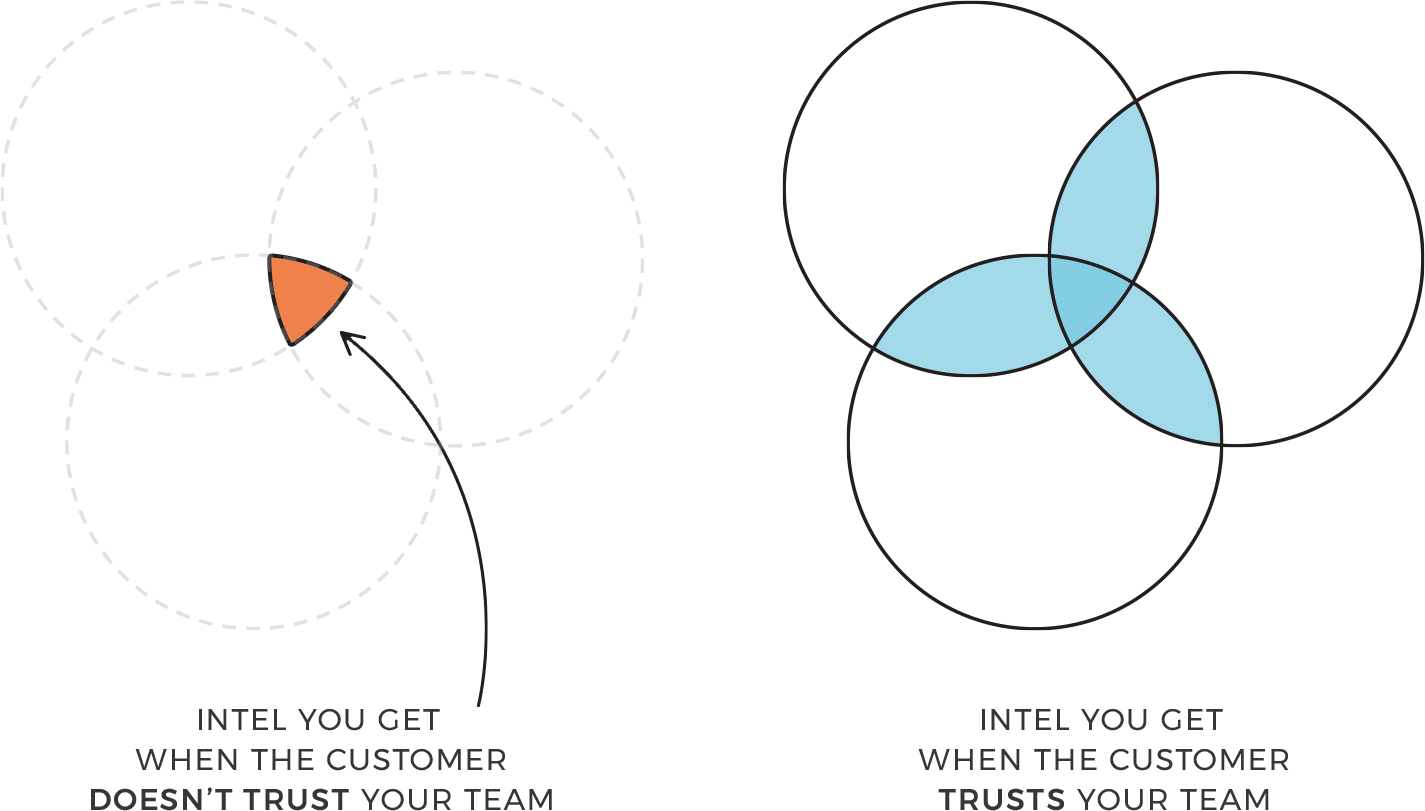
Government personnel deal with hundreds of contractors. They’re polite to everyone, helpful to some, but they only confide in people they trust. That’s where the real Intelligence lives—in the conversations that start with “Between you and me…” or “What I’m really worried about is…”
How Trust Actually Gets Built:
- Follow through on small commitments first:
If you say you’ll send something by Friday, send it Thursday. - Admit when you don’t know:
“I don’t have that answer, but I know who does” beats fake expertise every time. - Share intel that helps them look good:
Give them insights they can use with their boss. - Be consistent over time:
Trust builds through repeated positive interactions, not single impressive meetings.
Timeline Reality Check: Contract Type Determines Engagement Strategy
Contract type determines your relationship-building timeline. Start too late, and competitors are already positioned to win.
Contracting Timeline by Type:
- OTAs: 2-6 months ahead
- IDIQ Task Orders: 1-3 months ahead
- Standard Contracts ($1M-$25M): 6-12 months ahead
- Large Strategic Contracts ($25M+): 12-36 months ahead
- Recompetes: 12-24 months ahead
- Incumbents: Start in the penultimate contract year
- Challengers: Begin 18-24 months before expiration
Practical Engagement Approaches
Customer Engagement
1. Choose Where to Play Based on Your Company’s Maturity Level
Don’t spread thin. Concentrate your efforts where they count.
- Pick one agency/program office first. Map Decision Makers, Influencers, and Advisors across that office.
- Build institutional ties. Relationships should survive personnel turnover.
- Set intelligence goals. Three meaningful new conversations monthly—not pitches, but information-gathering discussions.
- Leverage certifications. Use SDVOSB, WOSB, or 8(a) set-asides as entry points.
- Target the right IDIQs. Vehicles like OASIS+ or CIO-SP4 shape the buying of IT and professional services.
- If you’re on them → build agency relationships
- If you’re not → focus on primes already on contract

The “Slow Burn” Strategy:
- Years 1-2: Focus on subcontracting while building prime contractor and government relationships
- Years 3-5: Leverage established relationships for prime opportunities and strategic partnerships
- Years 5+: Sustained competitive advantage through institutional relationship depth
2. Do the Homework Before the Meeting
Here’s the difference between contractors who wing it and those who win: preparation. While others show up hoping to “build rapport,” winners already know what their customers’ priorities are.
Track opportunities & forecasts:
- gov → forecasts & solicitations
- Agency Forecasts → official procurement forecasts
Analyze spending patterns:
- gov → federal award data
- gov (beta in SAM.gov) → contract data, recompetes
Monitor priorities & leadership:
- Agency websites & press releases
- LinkedIn for personnel shifts
Incumbent Intelligence Research
Use FPDS.gov and USAspending.gov to research current contract holders, their performance record, and whether there’s appetite for change. This gives positioning advantages without badmouthing incumbents—you’re doing competitive analysis.
How to Get Meetings: Beyond Cold Emails
Cold emails to government personnel have response rates below 20% and often get buried in inboxes.
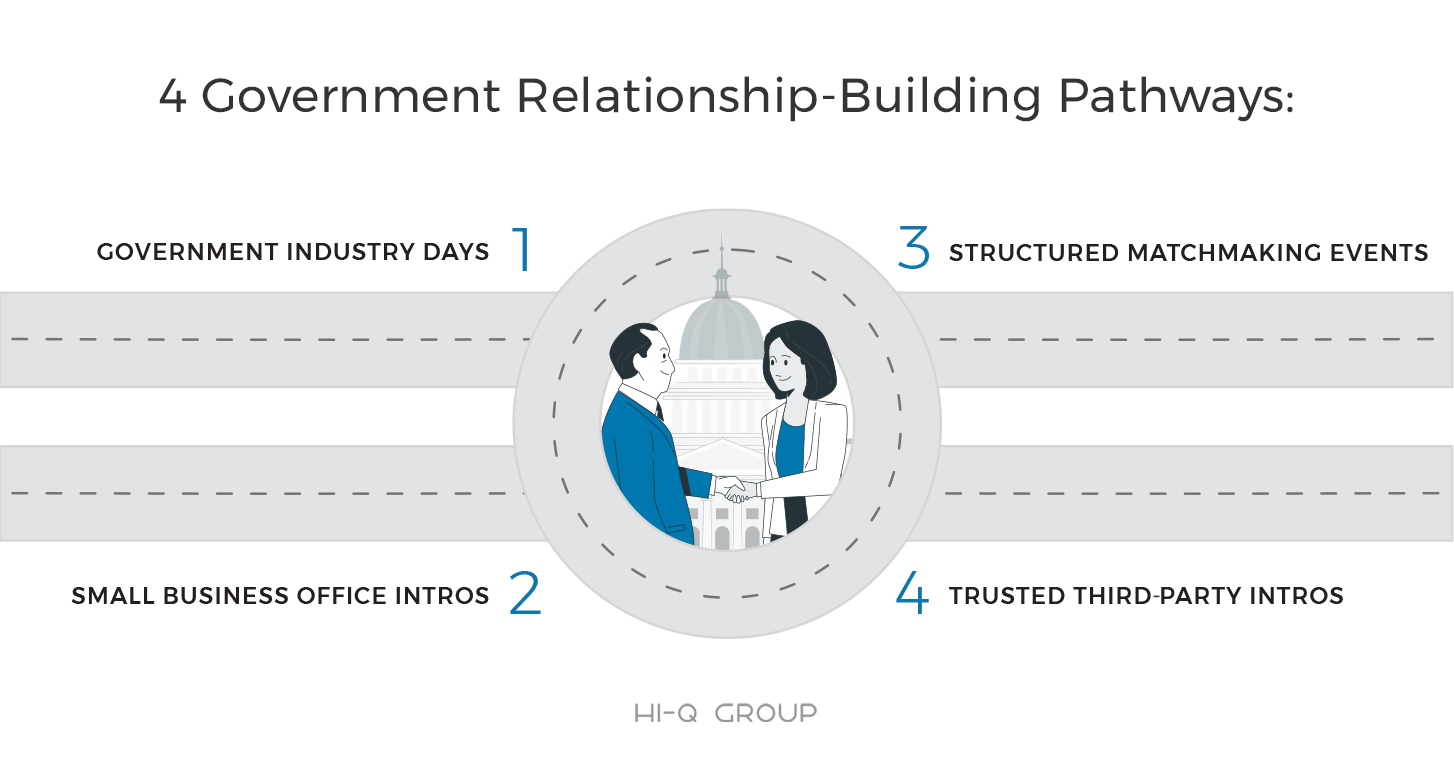
The contractors who consistently get face time with federal buyers use these 4 government-specific relationship-building pathways:
Pathway 1: Government Industry Days (Highest Success Rate)
Open forums where small businesses meet directly with contracting officials. Government personnel attend specifically to meet contractors, creating natural conversation starters and higher follow-up acceptance rates.
Execution:
- Research attending agencies and their expiring contracts
- Prepare agency-specific talking points and capability statements
- Schedule follow-up meetings on-site
Pathway 2: Small Business Office Introductions (Warm Referrals)
OSDBU offices, SBLOs, and small business specialists connect you directly to program offices. Their referrals carry internal credibility and bypass gatekeepers.
Process:
- Schedule a capability briefing and request introductions to relevant program contacts.
- Share agency-specific capability statement.
- Reference the referral in follow-up communications.
Pathway 3: Structured Matchmaking Events (Guaranteed Face Time)
Pre-scheduled 15-minute one-on-one meetings with federal buyers. Your capability statement is provided in advance, ensuring productive conversations.
Preparation:
- Research each buyer’s current challenges
- Prepare 3-5 diagnostic questions and relevant case studies
Pathway 4: Network Warm Introductions
Leverage trusted third parties to open doors with agencies and prime contractors. Warm introductions bypass gatekeepers and accelerate the development of relationships.
Network Sources:
- Former government colleagues, veterans, and retired officials
- Current contractor clients and industry partners
- Professional advisors and APEX Accelerators

As a defense industry contractor and business owner with over 20 years of experience, I can confidently say that this is the most impactful training I’ve ever attended for building and improving customer relationships.
The Hi-Q Engagement Method™
Success in government contracting requires systematic relationship intelligence gathering. The Hi-Q Engagement Method™ provides a proven framework that moves you from reactive proposal writing to proactive relationship building.
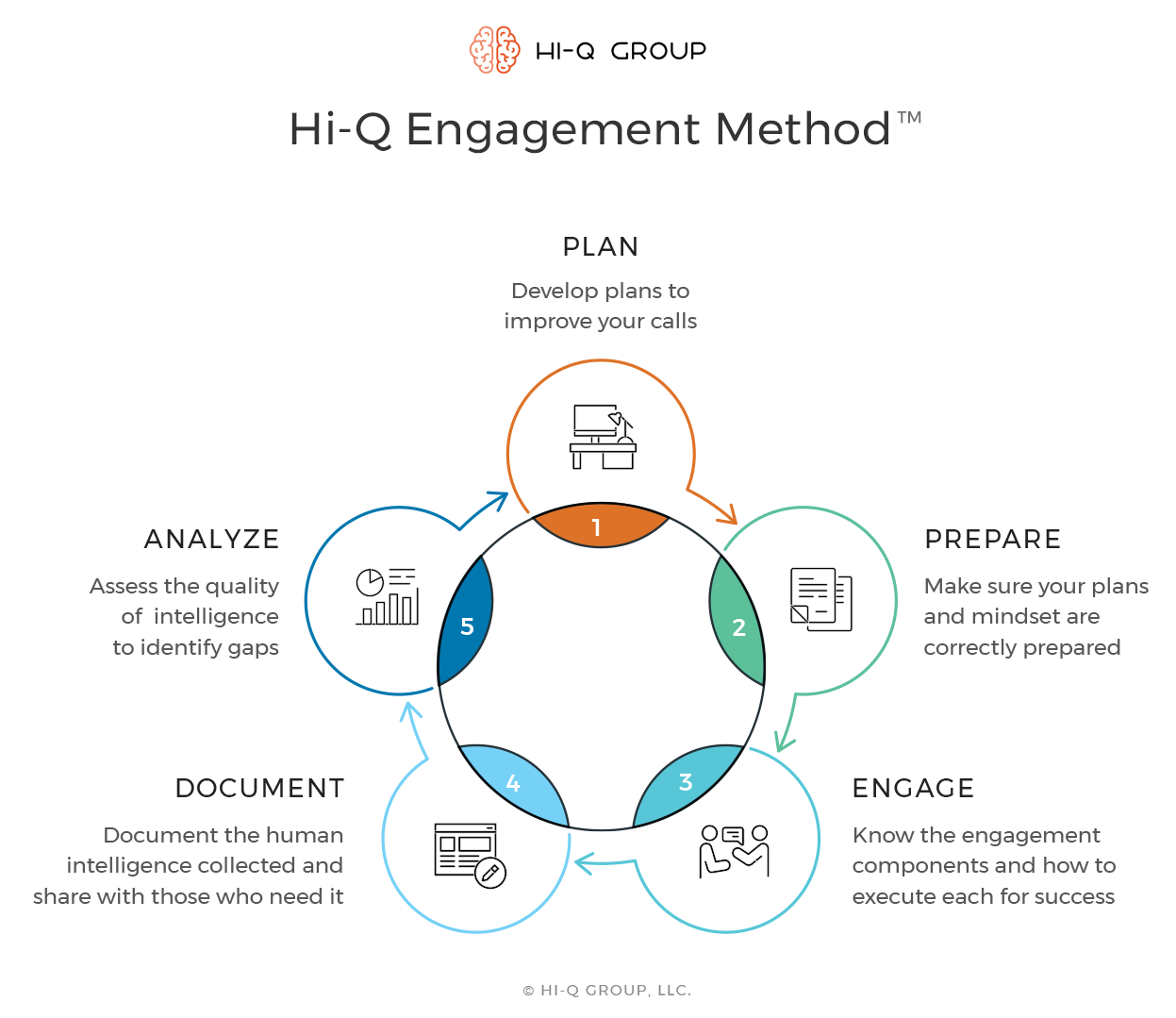
1. PLAN: Know What You’re Looking For
Key Principle: If you don’t know what you’re looking for, how will you know when you’ve found it?
Planning Essentials:
- Use the Hi-Q Target Opportunity Plan (TOP)™ to focus on critical human Intelligence.
- Identify potential contacts across all 3 tiers (Decision Makers, Influencers, Advisors)
- Hypothesize customer problems before engaging
- Goal: 3 new meaningful contacts monthly
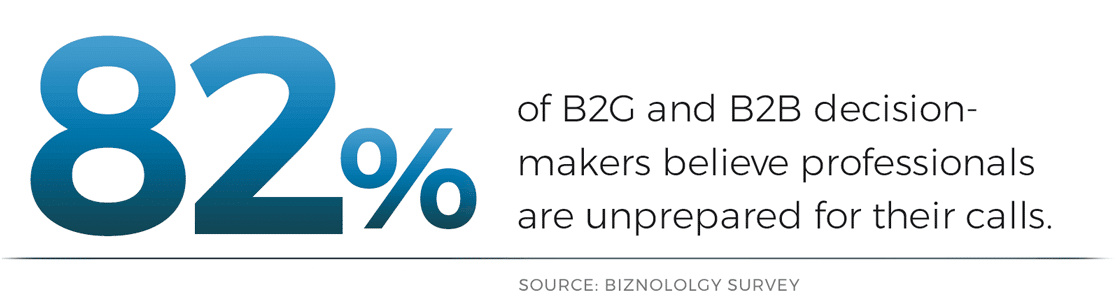
2. PREPARE: Get Your Questions Ready
Preparation Framework:
- Complete the Hi-Q Call Plan™ for every customer engagement
- Write out 5-10 discovery questions before every call
- Research pain/gain motivators for each contact
3. ENGAGE: Master the Conversation Skills
Core Engagement Principles:
- Be customer focused: Focus on understanding their world, not explaining yours
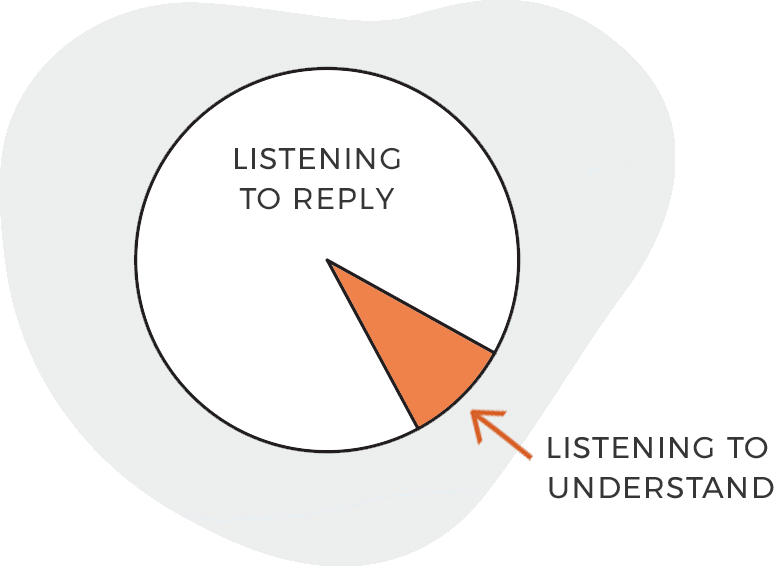
- Listen 80%, Talk 20%: Stay curious. Listen to understand, not to reply
- Avoid early solutions: Don’t pitch until you understand their problems
Practice the QLP Method™:
- Question: Ask one clear, short question
- Listen: Give them your full attention
- Pause: Wait 3 seconds before responding
4. DOCUMENT: Capture and Share Intelligence
Complete call reports within 24 hours documenting:
- What you learned (not what you said)
- Direct quotes when possible
- Commitments made by both sides
- Next steps and follow-up timing
4. ANALYZE: Turn Intelligence Into Insight
Key Principle: Gathering intelligence is only half the job: what you do with it determines whether you win.
Analysis Essentials:
- Assess the intel quality – Was it firsthand from a decision-maker, or secondhand from a consultant?
- Identify gaps – what do you still need to learn to qualify or shape the opportunity?
- Validate before acting – one source doesn’t make something true
- Update your TOP™ and call plan based on new intelligence
- Share relevant intel with internal stakeholders who need it to support the pursuit
These 5 steps represent a cycle, not a one-time checklist.
Elite professionals don’t stop at documenting what they heard; they pressure-test it and redirect their next engagement accordingly.
Overcoming the Fear Factor: Communication Confidence Building
Most contractors are brilliant at solving technical problems, but freeze up when it’s time to ask the hard questions that reveal real customer needs. Sound familiar?
You’re not alone. We’re taught early not to be “too nosy” or ask “too many questions.” But in government contracting, curiosity is your competitive advantage. Release the belief this will be seen as pushiness—you’re serving them by digging deeper.

Why Your Communication Skills Feel Rusty:
- Years of email and technical documentation instead of human conversations.
- Fear of sounding stupid or pushy with government officials.
- Assuming they won’t want to share sensitive information.
- Mistaking professional politeness for meaningful dialogue.
The Confidence Fix:
- Start with genuine curiosity:
“Help me understand…” is never threatening. - Ask permission to dig deeper:
“Would it be helpful if I asked a few more specific questions about that?” - Use the 3-second pause:
After they answer, count to three before responding—they’ll often add the most valuable intel - Acknowledge their expertise:
“You obviously know this area better than anyone—what am I missing?”
The First Meeting: Building Trust Through Diagnostic Questions
In your first meeting, your primary goal is simple: secure the second meeting by demonstrating value and understanding. Here’s how:
Pre-Meeting Preparation
- Send a brief agenda and background materials 24-48 hours in advance.
- Research their recent initiatives, budget challenges, and organizational priorities.
- Prepare 5-7 discovery questions showing a deep understanding of their world.
- Bring value-adds: relevant case studies, industry insights, or strategic introductions.
During the Meeting: The 80/20 Rule
Listen 80% of the time, talk 20%.
Use diagnostic questions to uncover unstated needs.

Discovery Questions That Work:
- What are your priorities for this program?
- Where do you see the biggest gaps between current solutions and actual operational needs?
- What challenges are you facing that aren’t being addressed by current vendors?
- How do you measure success in your role, and what obstacles prevent you from achieving those metrics?
Meeting Conclusion Strategy
- Ask them what they would like the next steps to be:
“”Based on what we discussed, what would you like the next steps to be?” - End with specific action items:
“I’ll send you that report by Friday” or “Let me introduce you to [relevant contact] next week” - Schedule follow-up before you leave:
“Would you like to see our approach to [specific challenge] in two weeks?” - Send thank-you within 24 hours:
Include meeting summary and action items
Reading Between the Lines: Emotional Intelligence in Government Relationships
Government customers buy based on how they feel about you, but they’ll never tell you that directly. They’ll talk budgets, technical requirements, and compliance—but the real decision happens at the gut level.
The Unspoken Signals:
- Energy shifts when certain topics come up—lean into those areas
- Repeated concerns about the same issues—that’s where they need your help most
- Questions about your other customers—they’re wondering if you’re reliable
- Comments about past vendor problems—they’re testing if you’ll be different

Eye-opening: “It will open your eyes to a whole new approach to customer engagement.”
Tools & Advanced Tactics
Why You Need a CRM (And It’s Not What You Think)
Most contractors think CRMs are just digital rolodexes. Wrong. Your CRM is your competitive intelligence war room.
Here’s what happens without one: Sarah has a great conversation with a customer program manager about upcoming requirements. Two weeks later, your PM talks to the same person without providing any context.
Result? They believe your company doesn’t communicate internally—and they might be right.
What Your CRM Actually Does:
- Intelligence Repository: Customer insights don’t walk out the door when employees leave
- Team Coordination: Everyone knows the latest Intelligence before engaging
- Intelligence Sharing: Proposal teams access real customer pain points instead of guessing
- Competitive Edge: Companies using CRM systematically win 30% more often
- Relationship Tracking: Never let relationships go cold due to poor follow-up
The CRM isn’t about the tool—it’s about capturing customer insights that might otherwise get lost in email threads or forgotten in hallway conversations.
Virtual Networking: When Your Travel Budget is Limited
Your competitors are flying to DC for industry days while you’re stuck in your office eating sad desk salads. Here’s how to build the same relationships without leaving your desk (or changing out of your sweatpants):
Government Virtual Events: Show Up Where They Are
Government agencies frequently host online industry days. The secret isn’t just attending—it’s being the person who asks thoughtful questions and actually follows up within 48 hours.

Most contractors lurk silently in virtual events like digital wallflowers. Don’t be that contractor. Participate in Q&A sessions, engage with speakers, then send a personalized follow-up email referencing something specific from their presentation.
LinkedIn: Your New Best Friend
Government personnel are surprisingly active on LinkedIn, sharing budget updates and industry challenges. Instead of lurking, engage strategically:
- Comment thoughtfully on agency posts (not just “Great post!”)
- Share relevant insights and tag government contacts
- Send connection requests that reference recent events or shared interests
(Be sure to follow our senior partner, Nic Coppings on LinkedIn for more GovCon insights.)
Host Your Own Virtual Sessions
Stop waiting for invitations—create them. Offer virtual capability briefings or host “lunch and learn” sessions on industry trends. Government personnel will attend if you’re solving their problems, not just pitching your services.
Everyone Should Have a Growth Role
Companies spend thousands getting their business development team face time with program managers, then send delivery teams on-site with zero relationship training.

Meanwhile, your project manager has coffee every morning with that same program manager. Your SME troubleshoots directly with the technical team. Your on-site staff hears daily complaints and “I wish we could…” conversations that never make it into official meetings.
Guess who the customer trusts more after six months? It’s not business development with quarterly PowerPoints in hand.
Problem: Delivery Teams Are an Overlooked Goldmine
Most delivery team members don’t realize they have a growth role. They hear customers vent about budget pressures and operational challenges, but treat these as problem-solving sessions instead of intelligence-gathering opportunities.
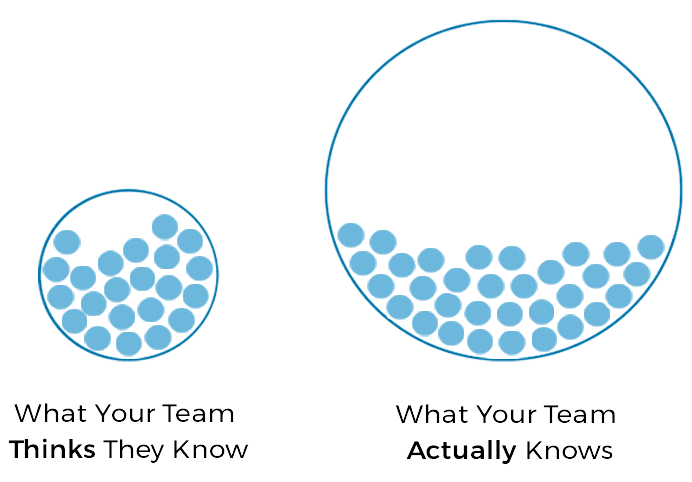
Most delivery team members don’t realize they have a growth role. They hear customers vent about budget pressures and operational challenges, but treat these as problem-solving sessions instead of intelligence-gathering opportunities.
Common Missed Opportunities:
- Technical Tunnel Vision: Focus solely on task completion while missing strategic conversations about future needs
- Excluded from Strategy: Forced to develop solutions without customer input, missing critical relationship advantages
- Unrecognized Intelligence: Daily exposure to customer frustrations and budget concerns without training to recognize on-contract growth opportunities
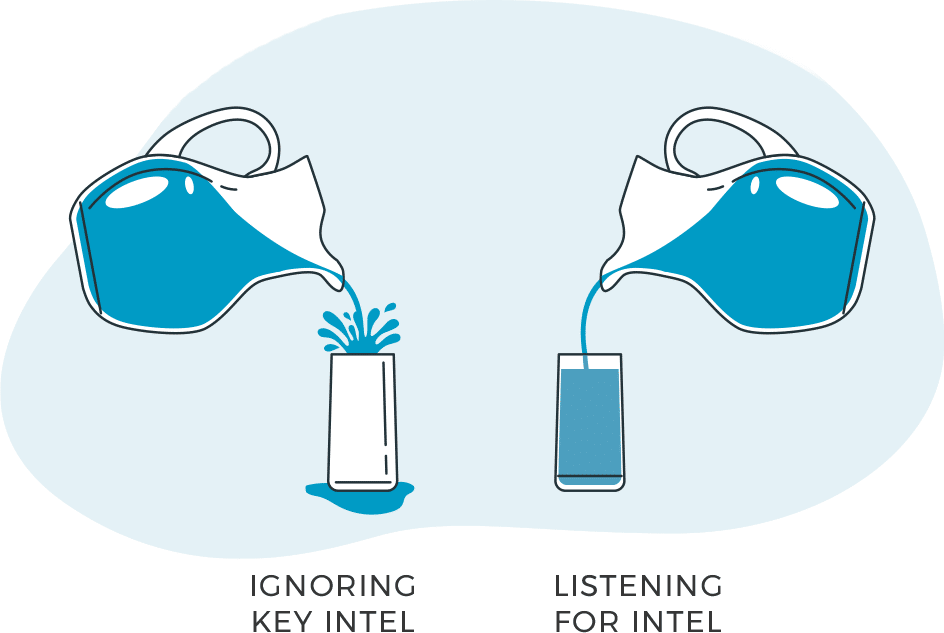
Solution: Train Everyone as Intel Gatherers
Teach customer-facing teams to:
- Listen for discussions that signal upcoming recompetes
- Ask follow-up questions when the customer vents: “Is there something we could do to help?”
- Document customer insights in your CRM for follow-up
- Recognize that every conversation is both service delivery and competitive intelligence gathering
From Problems to Partnership:
When Things Go Wrong, Relationships Get Stronger
Here’s something most contractors get backwards: Customer complaints and project struggles aren’t relationship killers—they’re relationship makers. When handled right, problems become your strongest competitive advantage.
The Problem-to-Partnership Process:
Step 1: Don’t Defend, Diagnose
- Customer: “This system isn’t working the way we expected.”
- Wrong response: “But it meets all the technical specifications…”
- Correct response: “Help me understand what’s not working the way you need it to.”
Step 2: Take Ownership of Their Problem
- Even if it’s not technically your fault, it becomes your opportunity
- “Let me figure out how to fix this,” beats “That’s not our responsibility.”
- Document the real impact on their mission, not just technical metrics
Step 3: Solve Beyond the Contract
- Bring in expertise from outside your contract scope if needed
- Connect them with resources, even if you don’t profit from it
- Think like their internal consultant, not an external vendor
Strategies for Subcontracting and Partnerships
Large integrators maintain hundreds of strategic partners to fill capability gaps and access specialized expertise. Success requires both demonstrating maturity and building strategic relationships that help partners win.
Strategic Positioning Through Value-First Engagement
Lead with Intelligence, Not Capabilities:
- Share market research about agencies where you both compete
- Provide insights about upcoming recompetes in your expertise area
- Offer introductions to government contacts in agencies they want to penetrate
- Present analysis of competitor positioning and partnership strategies
Fill Strategic Gaps:
- Geographic coverage where partners lack presence
- Specialized expertise complementing their core offerings
- Access to contract vehicles, certifications, or clearances they don’t have
- Small business status, helping meet subcontracting goals (where applicable)
Discovery Questions That Reveal Partnership Potential:
- “Where are you losing to competitors, and what additional capabilities would change that outcome?”
- “What opportunities are you tracking where you need deeper expertise than your core team provides?”
- “Which upcoming recompetes have you most concerned about capability gaps?”
- “What would make the difference between winning and losing your next major pursuit?”
Navigating Ethics and Compliance
Government relationship building requires staying within legal boundaries—when government folks start getting uncomfortable, you’ve crossed a line.
The key is building legitimate business relationships while following procurement rules. When in doubt, consult legal counsel. Ethics violations can result in contract termination, suspension, debarment, or criminal prosecution.
Overcoming Common Challenges with Advanced Engagement
Even with solid relationship-building strategies, contractors face predictable obstacles. Here’s how to use strategic engagement to overcome the most common barriers.
Challenge 1: The “Incumbentitis” Risk
Despite technical excellence and stellar CPARS ratings, incumbents often lose recompetes by overestimating the quality of their relationships and underestimating the evolving needs of their customers.
Engagement Solutions:
- Conduct Third Party Assessments: Hire independent consultants or use trusted partners to conduct anonymous surveys with your government contacts 12-18 months before recompete. Ask specific questions about satisfaction levels, emerging priorities, and competitive positioning. This removes the bias of self-assessment and reveals blind spots that internal teams often miss due to familiarity or wishful thinking.
- Customer Relationship Score (CRS): Implement a scoring system to track the quality of customer relationships. Score each relationship and create action plans to enhance and improve it. Track trends over time and correlate scores with win rates to validate the accuracy of your assessment.
- Expand Your Network: Map the complete organizational structure of your customer agency, identifying decision-makers, influencers, and emerging leaders three levels above and below your current contacts. Schedule monthly “coffee meetings” with new contacts to gain a deeper understanding of broader agency directions, budget priorities, and upcoming initiatives that may impact your program. Aim to have meaningful relationships with at least 8-12 people across different organizational levels.
- Train Delivery Teams: Transform your project managers and subject matter experts into intelligence-gathering assets by teaching them diagnostic questioning techniques. Provide templates for customer conversations that naturally uncover competitive intelligence: “What are some evolving priorities you hadn’t anticipated?” “If you could change one thing about how we deliver, what would it be?” “What do you see as the biggest risks for the recompete?” Document insights in a shared CRM system accessible to your capture team.
Challenge 2: Personnel Changes and Low Response Rates
Government personnel change frequently, and a large majority of government buyers ignore cold outreach. Contract disputes or administrative roadblocks can further derail established relationships.
Engagement Solutions:
- Build Relationship Depth: Create a relationship matrix targeting 3-4 contacts in each agency at different organizational levels: senior executives (GS-15/SES), program managers (GS-13/14), and technical leads (GS-12/13). Develop unique value propositions for each level—executives want strategic insights, program managers need operational solutions, and technical leads seek peer expertise. Maintain regular touchpoints with each tier through role-appropriate channels: executive briefings, program reviews, and technical forums.
- Warm Introductions: Leverage your existing network by mapping connections between your contacts and target prospects to maximize opportunities. Use Small Business Liaison Officers (SBLOs) as relationship brokers; they’re incentivized to facilitate introductions and often have broad networks. Maintain relationships with former government employees who’ve transitioned to industry; they can provide introductions and insider perspectives. Ask for specific introductions: “I’d like to understand [specific agency’s] approach to [specific challenge]. Could you introduce me to someone who works on that?”
- Government-Sponsored Events: Prioritize industry days, vendor outreach sessions, and agency-sponsored networking events where response rates exceed 70% because attendees expect to engage with contractors. Prepare targeted questions that demonstrate knowledge of agency priorities and position your company as a thought leader. Follow up within 48 hours with specific value propositions referenced to conversation topics. Track which events yield the highest-quality connections and focus your limited time accordingly.
- Account Management: Create detailed contact profiles in your CRM system documenting each person’s background, preferences, priorities, and relationship history. Include personal details (alma mater, career path, interests) that facilitate relationship building. Develop transition protocols for when contacts leave, and immediately identify their replacements. Request introductions before departures. Create relationship “succession plans” that ensure continuity when your internal team members change roles.
Challenge 3: Budget Uncertainty and Organizational Disruption
Government budget cuts, continuing resolutions, and layoffs create unpredictable funding that disrupts relationship building.
Engagement Solutions:
- Diversified Relationship Portfolio: Treat relationship building like a financial investment portfolio—spread your relationship investments across multiple agencies, funding streams (base budget vs. supplemental), and program types (O&M, RDT&E, procurement). Allocate 60% of relationship efforts to your core market, 30% to adjacent markets, and 10% to emerging opportunities. Track the budget stability and growth trends of each agency relationship to identify which investments are most likely to yield opportunities during uncertain times.
- Mission-Critical Positioning: Focus your relationship-building efforts on programs that are considered essential infrastructure or national security priorities—these typically maintain funding even during budget cuts. Research which programs have bipartisan congressional support and consistent multi-year funding authorizations. Position your company as supporting mission-critical capabilities that would be difficult or impossible to cut. Document how your work directly supports agency mission statements and strategic plans.
- Relationship Maintenance During Cuts: Provide increased value to contacts facing difficult budget decisions by sharing relevant market intelligence, introducing them to potential cost-saving solutions, or connecting them with peers facing similar challenges. Offer to conduct complimentary briefings on industry trends that might help them make informed decisions. Avoid sales-focused conversations during crisis periods; instead, position yourself as a trusted advisor who understands their constraints and can provide strategic counsel.
Challenge 4: “Bid Everything” Bidding Approach
Contractors submit proposals to every opportunity they’re eligible for instead of focusing on winnable opportunities where they have more intel than just an RFP.
Engagement Solutions:
- Qualify Before You Bid: Develop an opportunity qualification framework that requires customer intelligence before bid decisions. Create a scoring matrix that evaluates: customer relationship strength (Do we know the key decision-makers?), competitive positioning (Are we the incumbent or preferred vendor?), technical differentiators (Do we have unique capabilities?), and win probability (Based on relationships and past performance, what’s our realistic chance?). Require a minimum score threshold before investing in proposal development.
- Focus Strategy: Limit your annual pursuit portfolio to strategic opportunities where you can invest the time and resources needed for deep relationship building. Calculate the actual cost of proposal development (labor, overhead, opportunity cost) and ensure each pursuit has a minimum 40% win probability based on relationship intelligence. Assign dedicated capture managers to each strategic pursuit, allowing sufficient lead time for relationship development.
- Early Engagement: Begin relationship building long before the anticipated RFP release by engaging customers during their requirement development phase. Participate in industry days, request one-on-one meetings to understand mission challenges, and provide input during market research phases. Position your company as a trusted advisor who helps shape requirements rather than just responding to them. Track procurement forecasts and engage customers before opportunities appear on official solicitation schedules.
- Go/No-Go Discipline: Establish firm criteria for bid decisions and stick to them regardless of revenue pressure. Require evidence of meaningful customer relationships, competitive differentiation, and reasonable win probability before proceeding. Conduct formal go/no-go reviews with senior leadership using relationship intelligence as the primary decision factor. Be willing to pass on opportunities where you lack customer access or competitive positioning, redirecting those resources to more promising pursuits.
Challenge 5: Technical Focus Over Relationship Focus
Technical teams believe superior solutions automatically win, underestimating the role of relationships in government contracting.
Engagement Solutions:
- Cross-Functional Teaming: Create integrated capture teams that pair technical experts with relationship builders for every customer engagement. Train engineers and scientists in the fundamentals of relationship-building, including active listening, questioning techniques, and developing value propositions. Establish joint objectives where technical leaders are measured on relationship metrics (number of customer technical exchanges, depth of problem understanding) alongside traditional technical metrics. Include business development professionals in technical discussions to translate capabilities into customer value.
- Problem-First Approach: Use customer relationships to understand operational pain points before developing solutions. Schedule regular “problem discovery” sessions where technical teams listen to customer challenges without immediately proposing solutions. Document recurring customer problems across multiple relationships to identify market-wide technical needs. Develop solutions that address real operational challenges rather than showcasing impressive technical capabilities that may not solve actual problems.
- Technical Relationship Building: Empower your subject matter experts to build direct relationships with government technical counterparts through professional associations, technical conferences, and collaborative research projects. Facilitate peer-to-peer technical exchanges where your experts and government experts share knowledge on mutual challenges. Establish technical advisory relationships in which your experts offer ongoing consultation on emerging technology trends and implementation strategies. These technical relationships often provide the most credible competitive intelligence.
- Solution Validation: Test your technical approaches with customers through formal and informal feedback sessions before submitting your proposal. Conduct technical exchange meetings where you present conceptual approaches and gather customer input on feasibility, desirability, and implementation challenges. Use customer feedback to refine technical solutions and demonstrate customer collaboration in your proposals. Document customer validation of technical approaches as competitive differentiators that prove solution viability and customer buy-in.
Challenge 6: Rebuilding After Lost Bids
Contractors often abandon relationships after losing competitions instead of using setbacks as intelligence-gathering opportunities.
Engagement Solutions:
- Professional Debriefing: Request a debrief session within 30 days of receiving loss notification, preparing specific questions about evaluation criteria, competitive positioning, and opportunities for improvement. Approach debriefings as learning opportunities rather than complaint sessions—demonstrate genuine interest in understanding customer perspective and improving future proposals. Document all feedback systematically and share insights across your organization to enhance future capture efforts. Maintain a professional demeanor and express appreciation for customer feedback, positioning your company as a mature partner that learns from setbacks.
- Competitive Intelligence: Analyze winning proposals (if available through FOIA) and study successful competitors’ approaches, team composition, and value propositions. Build relationships with winning competitors through industry associations and teaming discussions—they may become partners on future opportunities. Research winning companies’ past performance and customer relationships to understand their competitive advantages. Use competitive intelligence to identify gaps in your own capabilities or approach that contributed to the loss.
- Future Positioning: Leverage loss debriefings to understand evolving customer requirements and position for future recompetes or related opportunities. Ask specifically about anticipated changes in upcoming solicitations and emerging customer priorities. Use loss as an opportunity to propose alternative ways to support the customer’s mission through different contract vehicles or partnership arrangements. Demonstrate how you’ve addressed debriefing feedback through capability investments, team improvements, or process changes.
- Relationship Repair: Address any damaged relationships from the competitive process through transparent communication and value-added engagement. Acknowledge any missteps in the competitive process and outline specific steps taken to prevent future occurrences. Re-engage customers through non-solicitation touchpoints: industry insights, technical discussions, or market intelligence briefings. Demonstrate that your company can maintain professional relationships despite competitive disappointments, thereby positioning itself for future partnership opportunities.
- Documentation: Maintain detailed records of all government interactions during the competitive process to demonstrate compliance with procurement regulations and professional conduct. Document customer feedback, competitive intelligence, and lessons learned in accessible formats for future capture teams. Create post-loss reports that analyze relationship factors contributing to the outcome and recommend relationship-building strategies for future competitions. Use documented insights to improve qualification criteria and relationship development processes.
You Can’t Improve What You Can’t Measure
Stop measuring activity and start measuring results. Your relationship building should work like any other business investment—you need to know what’s working and what’s not.
Customer Relationship Score (CRS):
Most contractors think they have great customer relationships until they lose a recompete. Hi-Q Group’s CRS methodology measures relationship quality across trust level, emotional connection, and strategic alignment—giving you actionable data instead of wishful thinking.
What to Track for Each Target Agency:
- Key decision-makers identified across organizational levels (program managers, COs, technical staff)
- Relationship quality scores and coverage gaps in critical functions
- Competitive positioning relative to other contractors
- Institutional relationship continuity despite personnel changes
For comprehensive government contractor KPIs, visit our comprehensive KPI guide, covering 85+ KPIs for business development managers.
Monthly Reality Checks
Ask yourself: Which relationships are actually moving your business forward? Where are you getting the best competitive intelligence?
Stop investing in low-return activities and double down on what converts to opportunities.
Case Studies, Examples & Assessments
If you liked this article, download our full government contractor relationship guide to continue reading:
Why this matters right now
Every competitor can match your technical capabilities or undercut pricing.
What they can’t replicate are the deep, trust-based relationships your team builds through genuine, ongoing engagement: insights that shape RFPs, reveal hidden needs, and reveal early opportunities before bids even drop.
That’s what wins contracts. Not a better proposal. Not a lower price. The relationship that was built months or years before the RFP dropped.
The next era of government contracting success belongs to firms that know how to create human connection and gather deep human intelligence that can’t be replicated by AI. Leading organizations recognizing this now will turn their teams into an unbreakable advantage—real, institutional ties that endure turnover, budget shifts, and policy changes, delivering 2-3x higher win rates through proactive positioning.
Those that do not will fall behind, stuck in reactive “spray-and-pray” cycles, watching win rates plummet, growth stagnate, and incumbency erode. The problem won’t be market size or expertise. It will be that their people were never trained to build trust, listen for new opportunities, map stakeholders, or turn daily interactions into strategic intelligence.
The bottom line:
Improving government contracting relationships starts by training your teams to build trust and find opportunities to add value in every conversation. By measuring your progress, you can close gaps systematically. Your next big contract isn’t hiding in forecasts alone—it’s emerging daily in your team’s outreach.
The question is, does your team know how to connect and listen?
improve your pwin
You’ve seen how blind bidding lets rivals gain critical intel and shape bids.
Trusted relationships are proven to help you meet your targets.