
TURN CUSTOMER CONVERSATIONS INTO PREDICTABLE GROWTH

Leaders start by checking their current setup. Use assessment tools to spot gaps in gathering, sharing, and using customer data. High-performing teams act fast and tie insights to business decisions, which means responding quickly to what the data shows and using it to guide choices that affect the bottom line. Segment customers by value to focus on high-revenue ones, so you put more effort into the accounts that bring in the most money and have the biggest potential for growth.
Customer-centric firms often double revenue growth by building a culture where everyone uses customer intelligence for decisions—this happens because they align the whole organization around understanding customer needs, leading to smarter strategies, fewer mistakes, and stronger market positions. In CEO or CRO roles, set clear goals like better forecasting to predict sales more accurately and avoid surprises. Train teams to capture customer preferences and customer feedback from calls, so they learn what customers really want during everyday interactions. Build cross-team processes to share intel, ensuring info flows between departments without getting stuck. Track results with metrics on revenue and retention to see what’s working and adjust as needed. This turns customer intelligence into a plan that drives account-based growth and sales performance, helping you target specific customers for expansion and close deals faster.
A good strategy has three main parts: people, processes, and tools. People include frontline teams who spot customer behaviors and customer sentiment, picking up on how customers act and feel during interactions to uncover deeper insights. Processes cover how you collect and share info, like standard ways to note customer preferences during talks, which ensures consistent capture of details that matter for decisions. Tools like customer relationship management systems or customer data platforms handle the data side, organizing and analyzing info to make it easier to access. Focus on speed and tying insights to outcomes like revenue, so you get quick value that directly impacts financial results.
Use segmentation for B2B customer intelligence to improve retention, grouping customers by similar traits to tailor approaches that keep them around longer. Link it to the full customer journey for twice the growth potential, as this maps out every step from awareness to loyalty and spots opportunities to improve at each point. Add human elements to avoid shallow data, bringing in real-world context to make the strategy more effective. Measure success by improvements in customer satisfaction, customer loyalty, and business intelligence that informs marketing strategy and product development, showing how well you’re meeting needs and innovating based on real input.
In B2B, deals are complex with many people involved. Human intelligence—from real talks—catches things like tone or hidden pains that data misses, revealing subtle clues about what customers really need or where issues might arise. It’s key to turn customer data into true understanding, adding the “why” behind the numbers to make insights practical. Without it, strategies fail to build strong client relationships or spot behavioral patterns, leading to missed connections and opportunities that slip away. Artificial intelligence needs human context for reliable insights, as tech alone can misinterpret data without the empathy and nuance people provide.
B2B customers expect firms to know their info deeply, which humans deliver through empathy that builds trust and rapport. It leads to better customer experience and revenue by creating personalized interactions that feel genuine and drive repeat business. For CROs, it means better client engagement and relationship mapping, helping you understand networks and dynamics within accounts for more effective sales. Ignoring humans leads to weak B2B customer intelligence and lost deals—that’s a hard truth many overlook, as it results in superficial strategies that don’t hold up in competitive markets.
Challenges include silos, bad data quality, and resistance to change. Start with an assessment to find gaps, reviewing your current practices to identify where info gets lost or blocked. Train teams on CRM processes and sharing intel across sales, support, and delivery, so everyone knows how to input and access data effectively. Use artificial intelligence for quick insights but with human checks to ensure accuracy and add context. Recommend self-service tools for B2B to cut costs and boost satisfaction, allowing customers to find answers on their own while freeing up teams for deeper work. Build capabilities for the whole organization, investing in skills and systems that everyone can use.
For CEOs, align incentives so teams share customer feedback, rewarding those who contribute insights that help the business. Fix data management platforms to ensure clean info, regularly updating and verifying data to avoid errors. Add artificial intelligence for patterns, but pair it with human judgment to interpret findings correctly. This improves client engagement and turns obstacles into wins for revenue and retention, creating a smoother operation where challenges become stepping stones to stronger performance.
CRMs store customer data well but often lack context from real talks. They become “data dumps” without human input, leading to stale info—91% goes bad in a year, becoming outdated or irrelevant and useless for decisions. Intelligence platforms use business intelligence but miss customer sentiment or preferences if frontline insights aren’t added, resulting in incomplete pictures. They need better ties to outcomes, connecting data directly to results like closed deals or growth.
B2B needs deep personalization, which tech alone can’t do, as it requires understanding individual needs beyond basic stats. Over-relying on them hurts customer experience by creating generic interactions that don’t resonate. In CRO roles, this means missed upsells and poor sales performance, with opportunities overlooked because the tools don’t highlight them clearly. The truth is, without fixing CRM processes and adding humans, these tools waste money and fail to drive real B2B customer intelligence, turning investments into frustrations instead of advantages.
Hi-Q Group breaks customer intelligence into three layers hidden in frontline teams: Surface Signals, Context Clues, and Human Intelligence. These layers show how basic data turns into deep insights that drive real business growth.
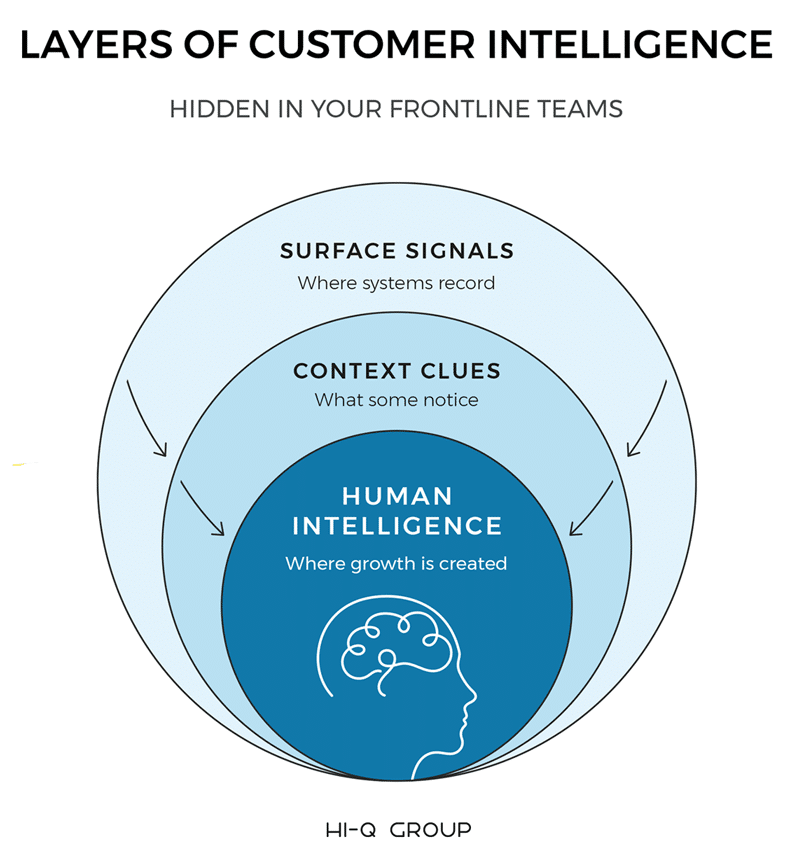
Unlocking all three layers makes frontline teams a strategic asset. It shifts from data collection to real advantage, but the hard truth is most organizations ignore the deeper layers, wasting potential and sticking with superficial metrics that don’t predict or prevent churn.
Investments focus on volume, not quality. Data goes stale fast without human context from conversations, losing relevance quickly and leaving teams guessing. Platforms collect customer data but ignore customer behaviors or sentiment, missing the emotional and practical sides. Many teams aren’t strategic enough, using tools without a plan to maximize them. B2B expects deep knowledge, but silos block it, preventing info from flowing where needed.
Only 15% use insights consistently, hurting revenue by causing inconsistent decisions and missed chances. Leaders in CEO roles assume tools fix everything, but poor data quality and no human layer leave gaps, leading to unreliable info. This leads to surprise losses and weak customer relationship management, where deals fall through unexpectedly. The objective truth: Most setups treat data as the end goal, not a tool for true customer intelligence, resulting in wasted resources and ongoing confusion.
Customer data is raw facts like clicks or purchases stored in systems. True customer intelligence adds context to understand why things happen, like customer preferences or sentiment, making it useful for real-world actions in B2B customer intelligence. Intelligence ties to decisions, guiding choices that affect the business. It links to B2B personalization, allowing tailored approaches that fit individual needs.
It drives twice the revenue by revealing behaviors, showing patterns that lead to better strategies and efficiency. Data alone is numbers; intelligence informs business decisions, marketing strategy, and customer support, providing the full story. Without the human part, data stays shallow and misses the full customer journey, limiting its value to basic tracking.
First, train teams to ask probing questions in talks to dig deeper into needs. Set standard processes to capture and share intel in CRMs, creating consistent habits for recording info. Add incentives for noting customer feedback, motivating teams to contribute more. Push for quick-turn insights to act on fresh info fast. Suggest segmenting for B2B focus, prioritizing key customers for targeted efforts. Start with pilots for fast wins, testing small changes to build momentum. For CROs, this boosts sales performance and account-based growth, closing deals quicker and expanding accounts. Measure impact on revenue and retention to refine the approach. This builds a system where conversations drive predictable growth, not just random chats, by turning one-off talks into ongoing advantages.
It reveals real customer needs, leading to better forecasts and personalized plans that match what clients want. It spots risks early for retention, catching issues before they cause churn. Traditional metrics like opens miss context; intelligence adds customer sentiment for accurate predictions, providing the full picture. Tie it to outcomes like revenue for direct impact. Use segmentation for B2B retention, focusing on groups to keep them satisfied. Customer-centric firms grow revenue twice as fast, boosting lifetime value through sustained relationships and repeat business. In CGO roles, it means higher customer loyalty and less churn through tailored touch points that feel relevant. Stronger intelligence makes revenue steady and retention high by focusing on what customers truly want, reducing surprises and building long-term stability.
Customer intelligence lets you tailor interactions based on preferences and behaviors. It spots pain points early, boosting satisfaction by fixing issues before they grow. It enriches experiences via social and analytics, combining online feedback with data for more engaging service. It links to twice the revenue through better journeys, as smoother experiences lead to more sales and loyalty. In CEO roles, use it for seamless customer support and loyalty, ensuring every touch feels thoughtful. This turns average service into standout customer experience, making customers feel valued and coming back.
Customer data shows patterns like buys or clicks, helping spot behaviors that indicate trends. But pair it with intelligence for why they happen, adding context to make sense of actions. Data alone is shallow, missing the deeper reasons behind choices. B2B firms must know behaviors for personalization, customizing offers to fit how customers act. Use it for insights that drive decisions, turning observations into strategies. For CROs, it improves behavioral patterns analysis for better sales, predicting moves and closing more effectively.
Good customer relationship management tracks interactions to meet needs fast. It builds trust through consistent service, showing reliability over time. It cuts costs while boosting satisfaction, streamlining processes to deliver value efficiently. Tie it to B2B expectations, meeting complex demands promptly. It leads to loyal customers by fostering ongoing positive experiences. Use it for personalized touch points that raise customer satisfaction, making each contact feel custom-made.
B2B customer intelligence uncovers stakeholder needs for deeper talks. It strengthens client engagement by spotting opportunities in conversations. Human signals are key for this, picking up on unspoken cues. Push for informed interactions that show understanding. It links to growth by building stronger bonds. In CRO roles, it means more meaningful client engagement and stronger relationships, leading to repeat business and referrals.
Customer analytics reveals preferences and feedback for better products. It informs what features to add, ensuring they solve real problems. High-performers use it strategically, aligning development with market demands. Tie it to innovation, creating items that stand out. For CGOs, it drives development that matches market needs, boosting revenue through higher adoption and satisfaction.